Mellotron M4000D
Walter Franklin
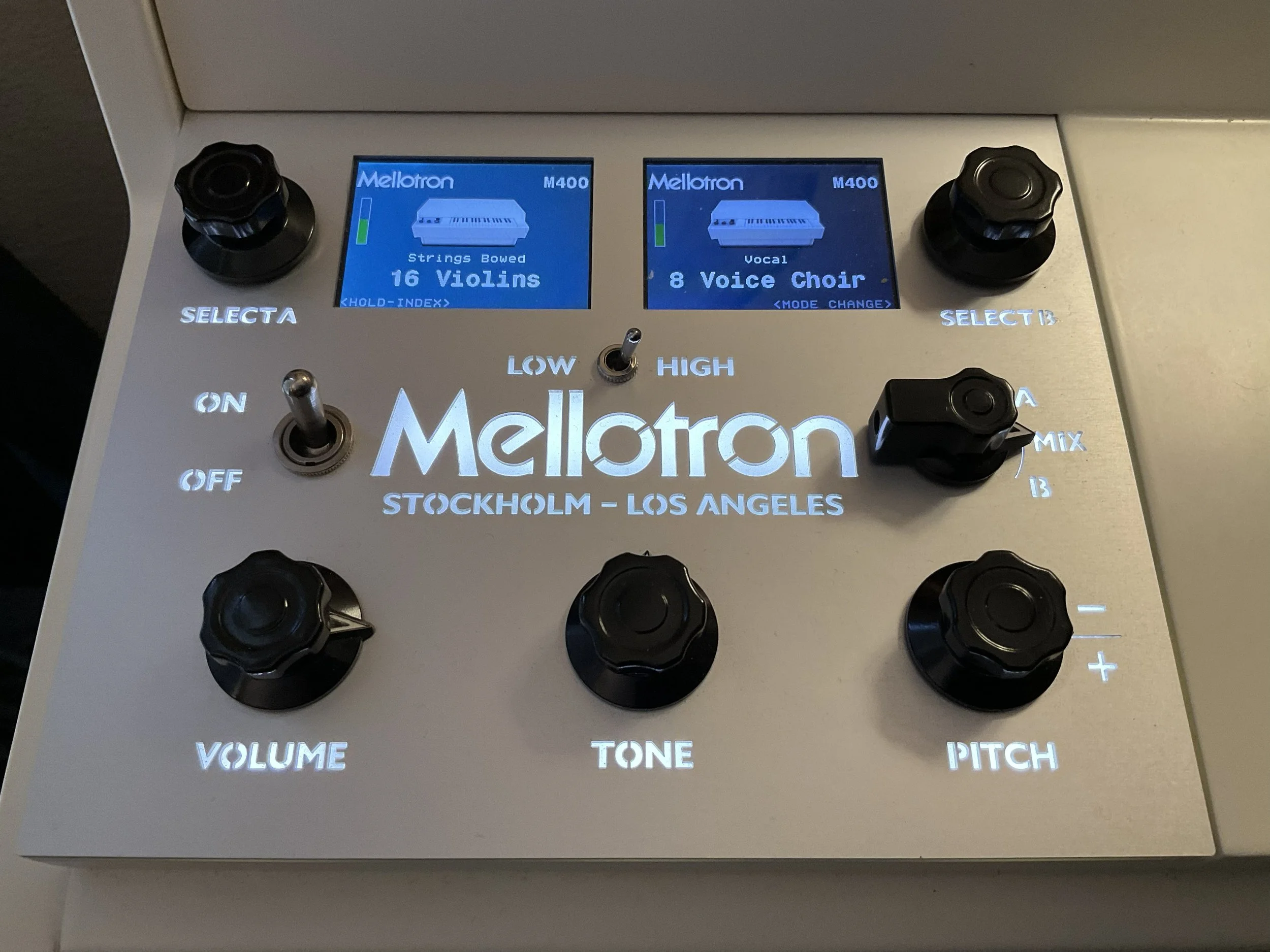
Control panel of my Mellotron M4000D
I’ve always loved the sound of the Mellotron, way before I even knew what a Mellotron was. I think it started with David Bowie’s “Space Oddity”. I couldn’t put my finger on it at the time, but I knew something was different about the way the backing strings sounded on that song – not quite natural, somewhat dissonant, a little bit scratchy and thin, but I loved it. It seemed to give the song a “not of this world” vibe.
The Mellotron is a keyboard first developed in England in 1963 that “plays” strips of audio tape prerecorded with the sounds of a variety of musical instruments – violin, flute, vocal choir, saxophone, church organ, marimba, and so on. Each tape strip contains a single note played in a particular pitch. As such, the Mellotron is part organ-like keyboard and part reel-to-reel tape deck – an audio-electro-mechanical mish mash of sorts. However, it was the only thing available back then if you wanted those orchestral sounds without hiring an orchestra. It was a big part of the Prog Rock scene of the 70’s with bands like Yes, Genesis, Moody Blues, and King Crimson, but it wasn’t just Prog Rock bands that used the Mellotron – it seemed like everyone used one at some point. Heck, even Lynyrd Skynyrd used a Mellotron on “Free Bird”. I could go on and on, but I’ll defer to other sources, such as Mellotron - Wikipedia, for more in-depth discussion of the development history and technical details.
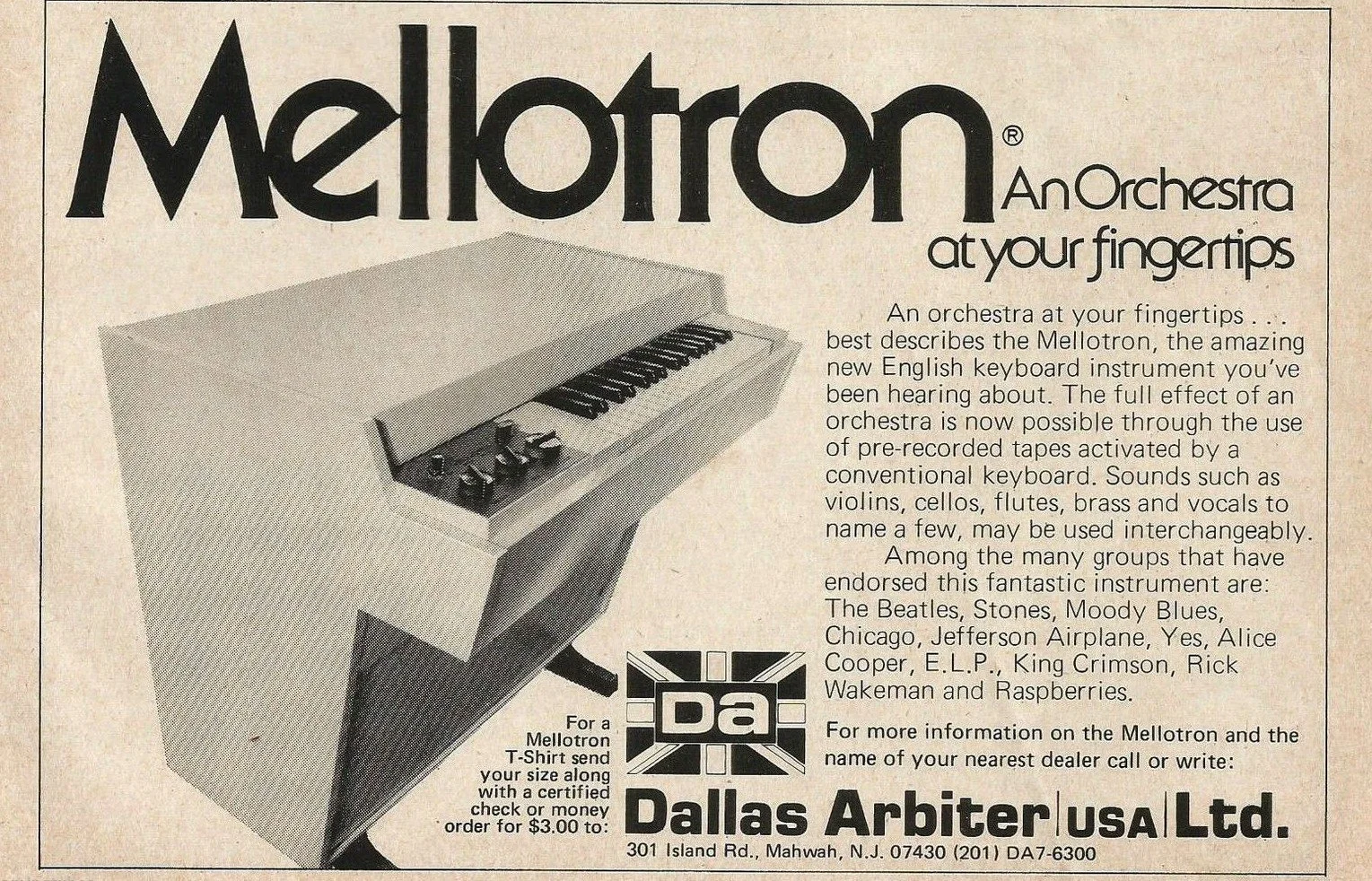
Vintage Mellotron Ad
Getting back to the sound --- a fair amount has been written on what makes the Mellotron sound so unique, but it really comes down to the nature of the individual strips of prerecorded audio tape and the associated tape transport & playback hardware. Pretty much any electro-mechanical tape device, such as a reel-to-reel tape recorder, introduces some degree of wow and flutter, and the same is true for the Mellotron. These small imperfections in tape speed can give it a subtle “warbly” sound. Also, there are small variations in the tuning of the individual notes from strip to strip that can give the Mellotron a slightly dissonant character. Think about it – they probably had a musician come into a recording studio and instructed him or her to “Play an F note for 8 seconds. Now play an F#. Now play a G ….” and so on. I’m sure it was a challenge to play each note in isolation and keep perfect relative pitch, at least for some instruments like strings. And then there are other intangibles – like how musicians interact when playing in a group setting. There is a two-way flow of information when musicians play as a group - not only does each musician listen to what they are playing, but they also listen to the other musicians and make subtle, real-time adjustments to pitch, tempo, volume, attack, vibrato, etc. as required. These small adjustments make the sum more cohesive, warmer, and fuller. The Mellotron does not necessarily have the capability to replicate these fine details. So, does all of this mean the Mellotron is a terrible instrument with a horrible sound? Just the opposite - it is precisely these supposed shortcomings that make the sound so alluring.
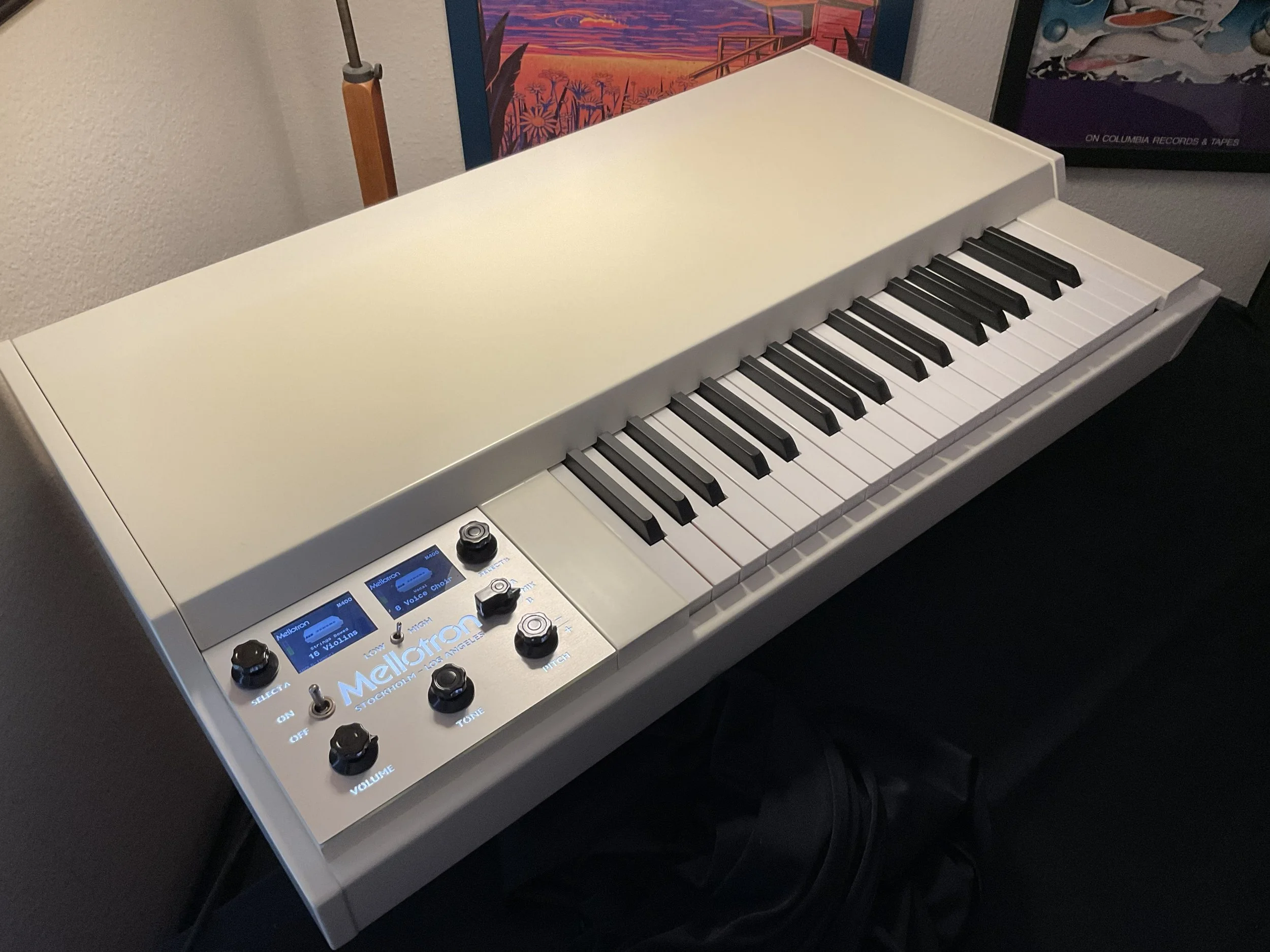
So, this brings me to the Mellotron M4000D – the model I own and use on a regular basis. The “D” stands for digital. I ordered my M4000D direct from Markus Resch of the Mellotron factory, located in Sweden, in August of 2011. I believe my order was part of one of the first production runs, maybe even the first. I didn’t receive my Mellotron until April 2012 due to delays in laser cutting the front and back panels, but it was well worth the wait.
You may ask - “A digital Mellotron? Doesn’t the digital aspect negate the essence of what makes the Mellotron a Mellotron?”. It’s a fair question. The digital recordings are taken from the actual first-generation Mellotron analog tapes, so the quality is probably better than you’ll find in most surviving vintage Mellotrons. Also, the M4000D comes loaded with 100 original sounds. The convenience of having immediate access to such a large selection of sounds is worth everything (and more original sounds are available from the Mellotron archives). Regarding factors like discrepancies in tuning, wow & flutter, etc. that add to the Mellotron’s unique voice - I believe those effects, at least to some degree, are captured in the digital copies of the original tapes. However, I would also expect the digital Mellotron can’t entirely capture every subtle variation inherent in a vintage instrument. Does it matter? All I know is my M4000D faithfully captures the sound and aura of the Mellotron, and having access to the full library of sounds, in a smaller and lighter package, and without the worries of mechanical breakdown or tape wear, make it the perfect choice for me.
You can see and hear my M4000D in action in the music videos Sound & Color – Got to Put 'Em Together - YouTube and Losing Daylight - Slipping Away, A Little Bit More Every Day
My Mellotron M4000D
5/9/2026